Oak
Grove Referendum
1.
What
is Oak Grove?
Oak Grove is a proposed housing development of 51 mega-mansions
built on the rolling hills on the south side of Pleasanton.
2.
How
big can those houses be?
These homes can be as large as 12,500 square feet!
These homes can be 3-stories tall for a height of 44 feet.
3.
How many trees
will be affected by this development?
More than 100 trees according the City,
but this number leaves out the many tees within building envelopes that
were not surveyed. Many trees are
taller than 35 feet and hundred or more years old.
4.
How
will the hills be changed for these houses?
The majority of houses are situated on the most visible
ridgelines of the site. This makes the houses more appealing for the
potential owners, but it also makes them visible throughout the
community. As alternatives to the highly visible ridgelines, there are
plenty of opportunities to put home locations in lower visibility
locations.
5.
Isn’t this property owner entitled to develop this parcel?
No. The property
owner already subdivided previously and created Kottinger Hills.
They have already made their money.
6.
Does this
property owner live in our community?
No. The property owner does
not even live in the United States.
This was land that as bought for speculation.
The property owners have no ties to our community.
7.
Has
this property owner proposed other developments in the Tri-Valley?
Yes. The developer
of this land is currently proposing a 21-story office building in Dublin
right by the freeway.
8.
I
thought the city was receiving a park by this property owner.
After the property owner subdivides and sells off their lots,
they do not want to pay the property taxes on the rest of their land
since it will not have further development potential. Also there will be
significant costs to maintain to prevent fire danger to the new homes so
they want to “give” it to the city.
The trails with provide great views of the mega-mansions.
There will only be 11 parking spaces for the trails so it is hard
to call this a park.
9.
Who
will maintain the trails and the open space?
The City will. The draft of
the Fire management plans has significant requirements for fire
abatement. So
the taxpayers of Pleasanton will be paying for the maintenance of this
property, which essentially is a scenic corridor for the mega-mansions.
10.
Is
there a fire danger problem for this development?
Yes. These homes
would be in a high-fire danger area.
Our fire and medical safety crew will not be able to reach an
emergency there within the 5-minute time that the rest of the community
has, and is in our General Plan.
The houses will have fire sprinklers but that only protects from
a fire started inside a home; not outside.
If somebody starts fire on a trail, the whole community can go up
in flames; including the adjacent residential neighborhoods.
11.
I heard this
project is a compromise and the adjacent property owners are satisfied
with it. Is that true?
No. Several individuals in
Kottinger Hills were in favor of this plan but it has not been agreed
upon by the Kottinger Hills Home Owners Association (board or members).
Also, the other residential developments that will be viewing
this property (Vintage Hills, Grey Eagle, Ruby Hills) were not even
consulted on it.
12.
I
heard that this plan has gone through an extensive planning process.
This is not true.
Not all the adjacent neighbors have been consulted with.
This is also the first project in the history of Pleasanton where
the development plan did not go through the scrutiny of the Planning
Commission.
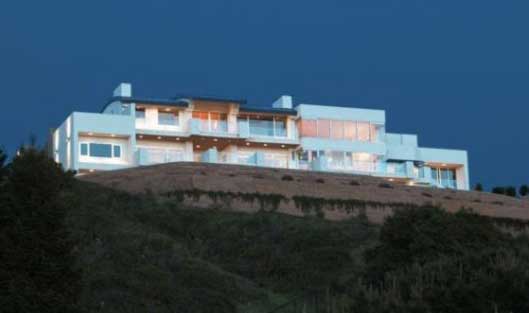
9000 sq ft home in the Oakland Hills. Is this what we want on our ridges?
NO, this is not what we want!
We look forward to working with developer and the community to find a solution that is consistent with the general plan, PP and is acceptable to the Pleasanton residents.
8 Reasons to Vote NO!
The developer touts the 8 reasons to vote yes, but these are actual 8 of the many reasons to vote NO. Click here
Bulldozers are lined up
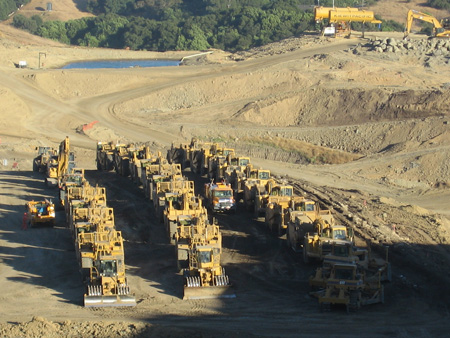
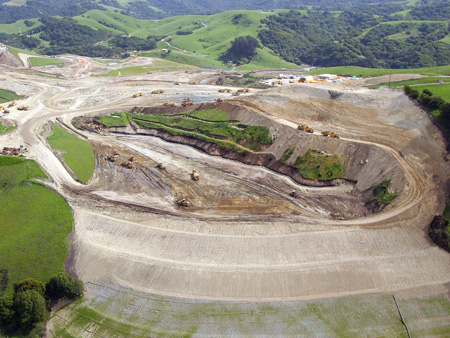
They will have to go elsewhere!
Sierra Club says NO Oak Grove
The local, regional, state and national branches of the Sierra Club urge you to Vote NO on Oak Grove because of the negative impact on the ridges and environment of Pleasanton's hills. Read their newsletter.
Learn the facts about the flyer
The glossy flyer sent Pleasanton residents shows the current hills, but what will happen to those hills and trees if Oak Grove is built? Click here
What can you do?
Visit us on Facebook

Get your T-Shirt!

Order now only a $10 donation!
Volunteer
If you are interested in helping save Pleasanton's ridgelines, please email us.
Donate to Save the Hills
We need funds to educate the voters about saving Pleasanton's Hills. If you would like to donate, please send a check to:
Save Pleasanton Hills
1246 Hearst Dr.
Pleasanton, CA 94566
or